
FliteLab* Amp Board Initial Thoughts
I guess karma is real. I just happened to get the new Flitelab Amp board on day one. I am not sure if I am the first, but I am close. Here are my initial impressions of the board. I have ridden it 5 times so far. I am using my Cedrus mast along with my Mike’s Lab 825, which is my go-to wing and favorite right now. This is the same setup I use on my Foil Drive, so Apples to Apples here. I am 145lbs, so keep that in mind.
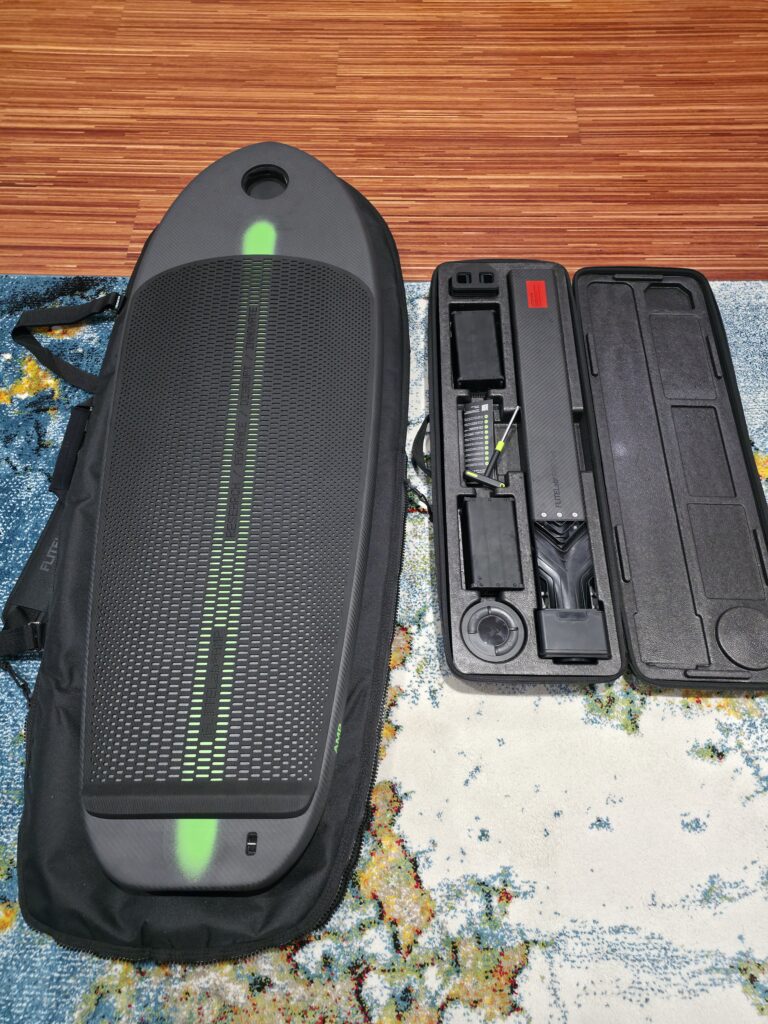
BUILD
I am impressed with the build quality. They really did take the time to think things through and make sure it is correct. I hated the wait, but maybe it was worth it. The board feels solid. The carbon lay-up is excellent and finished. The board is heavier than my 270-degree foil board. Here are the dry weights of each:
4’2” 270-Degree- 6.5 lbs.
Weight with mast & Slim battery: 18.8 lbs.
Weight with mast & Endurance Battery: 20.2 lbs.
4’6” Amp- 8.4 lbs.
Weight with mast and standard battery: 23.9 lbs.
For more info
4’8” Amp-9.7 lbs.
5’1” 270-Degree- 9.1 lbs. My downwind board.
The Amp board is complex in its design, and I would say that they have done a fantastic job keeping the weight down, but you can feel it. It is a little over 5 lbs. heavier than my 270-degree board. It felt more balanced in the 4’6” board, and I did not feel it when I was up and riding. The 4’8” I felt the weight. It is close to my bigger 270* board. It is still fine to turn and pump, but you get a more muted feel to it with the weight and length.
The deck pad is excellent, but I feel it is too much. It covers a large area of the deck, which I am sure adds to its weight. When it is wet, it retains a lot of water, adding more weight to the board. I may trim it down in the future when I know exactly where I stand on the board.
Assembly & Operation
Assembly is quick and straightforward. I feel like I am missing something compared to my Foil Drive, which is more complex. The battery lid gives a nice loud click, so you know it is in correctly. The Pod is difficult to turn into place on the deck of the board. It keeps it water-tight, but you need strong fingers to hold onto the little tabs for the rotation. Taller tabs or a tool would be helpful. When my fingers are cold, it may be impossible to rotate.
The controller’s Pod buttons are easy to access in the water and worked every time I pressed them, but a click or some sort of feedback would be reassuring that I got the press correct—nothing critical, but a V2 suggestion.

TAKEOFF
This is the crux of why you get this. I am a long-time Foil Drive rider. I am a little jaded because of that. I am used to just motoring into a wave or swell. The Foil Drive remote allows continuous and instant adjustments of the power. I hold it in my mouth and use my tongue to vary the power. During takeoff, I adjust the power depending on the wave characteristics. The Amp board does not allow this. Once you press the button, it goes through a set cycle of varying power. Moderate thrust ramps up to high thrust, then returns to moderate thrust before going off. The whole cycle is 10 seconds. I feel like this is a correct length of time. There are times when I want a few more seconds to get into the wave. There were several instances where I didn’t need the time, and the motor would spit out as I popped the board up. This required some adjustment in my balance to counteract the thrust, but it was easy to adjust to it. You can change the settings, but they are only for the variation in the cycle. Ten seconds is the max time, but you can shorten it. You will need to paddle. I mean paddle hard like you would normally do without a motor. This allows you to get into a wave much earlier than you would normally. I was able to take off with no paddling on a steeper wave that was almost breaking. When compared to a Foil Drive, there is no comparison. I do not need to paddle to take off on the Foil Drive. I can power into much softer waves since the low-end torque of the three blades leaves the Amp jet-drive in the dust. In addition, I can power for well over 10 seconds if needed and instantly adjust the power during that time. Take off effort on the Foil Drive is a one, and the Amp board is a 7 out of 10. Ten being no motor effort level. This effort level may decrease with more experience.
Pump & Glide
I am riding my Mike’s Lab 825. My favorite wing. The amp board does not change the glide characteristics of my foil. I find that the glide may even be better with the increased weight; it maintains the glide for longer. Pumping on the board is easier. I found that I can pump further with the Amp board than the Foil Drive one. I think this has to do with the weight distribution, along with the ability to get lower on the mast and not have a prop to catch and drag me down.
Turning
This is where the increased weight of the board and the distribution of that weight are a disadvantage. I initially rode the Amp board in small waves, and I was able to turn well, but not in the more radical way I would typically be able to. I thought this was just due to the waves. I went out in larger waves, and the weight of the board was really noticeable. I found that when I would lean into a turn, I would go nose down and blow the turn. I adjusted my weight distribution and even the mast position, but the weight of the board in the forward section still affects the turns more than I expected. Can I adjust to it? I am sure I can. I have only had five sessions on the board.
Battery Life
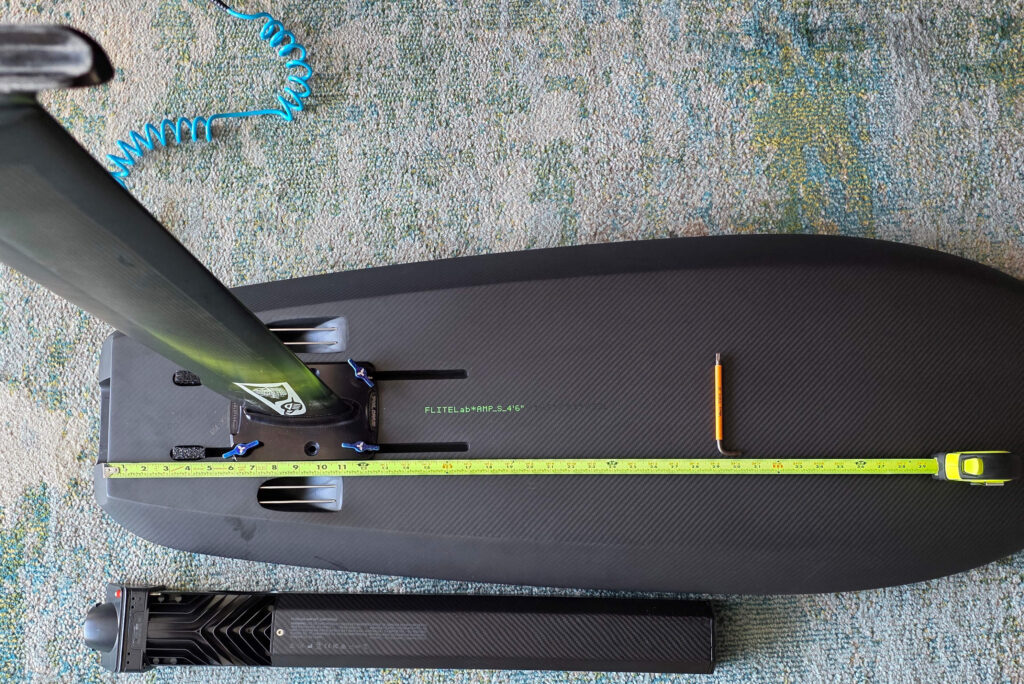
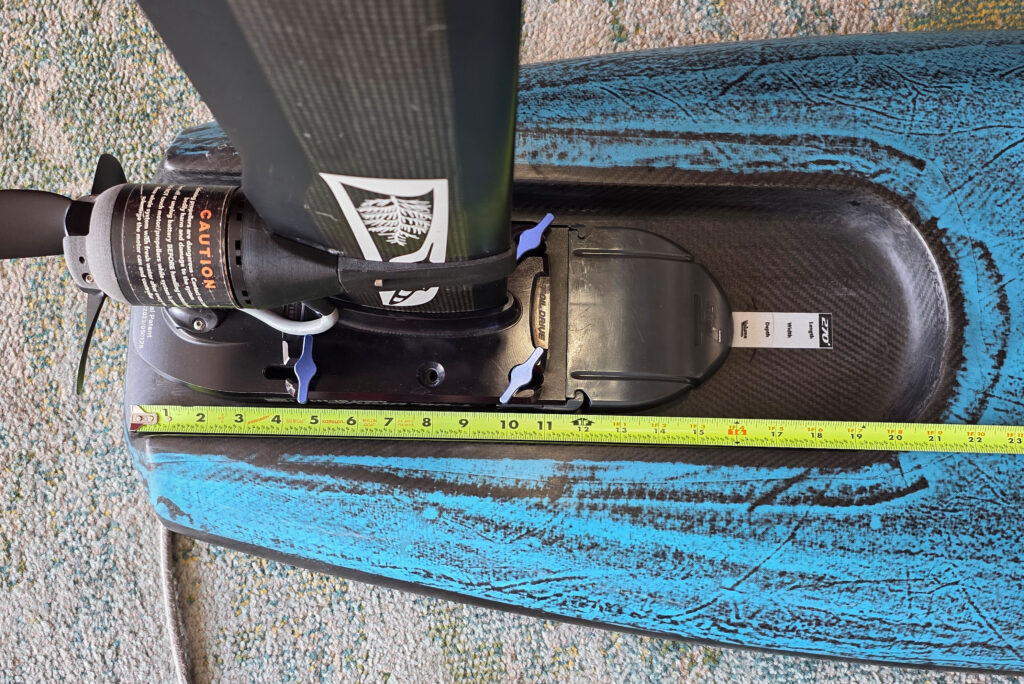
It is decent. I am coming from using the Slim and Slim Endurance battery. The endurance is closest to the Amp battery setup. In a typical session of my Foil Drive with the endurance battery, I can get about twenty waves in an hour and get out with 45% battery left. If I use the slim version, that would bring it down to 25% or less. I have averaged 12 to 15 waves per hour with the Amp board, and I come in with 15% battery. I try to conserve battery by pumping out as much as possible, regardless of the system I am using. The weight distribution of the battery in the Foil Drive is all in the back 16 to 18 inches of the board, or centered around the mast. The Amp board spreads this out along 29 inches from the back of the board.
Board Design
The overall shape and volume distribution of the board are excellent. I think they nailed that in the design of the board. My quip is with the volume. I ride a 4’2” board with 35 liters of volume. I had to go up in length due to the volume issue with the Amp board. The 4’6” is 32 liters, but it feels more like 29 liters with the extra weight of the board. I find that on takeoff, water splashes into my face. I never get that on my regular board since it has the extra volume to keep me above the water. Paddling takes more effort because you are lower in the water, where there’s more resistance. I tried the 4’8” board that is 40 liters, and it was much better. I could paddle it like a regular board, and I was able to get into softer waves with no face splash. My ideal Amp board would be 4’2” with 35 liters. I do not need more length, just more volume.
Questions I can think of to Answer
The question on everyone’s mind is, is it worth nine thousand dollars? I wish I could resolutely say yes. I think it is a bit pricey for an assist-type board. The build is excellent, and the simplicity of the design, along with the ease of putting it together, is better than the Foil Drive.
Who is this for? If you are not a great paddler or want to boost your wave count, this tool is perfect for you. If you are an experienced prone foiler, this will make your sessions more productive. If you have time constraints, this will allow you to get into more waves per hour.
Is it suitable for a beginner? No. The timing of when to press the button and get into a wave requires experience. Subtle balance shifts are necessary to maintain control of the board during takeoff. Learn on a regular board first and then progress to this system. I would not recommend a Foil Drive for a beginner as well.
Should I sell my Foil Drive and buy this? The answer is complicated. My initial response would be no. There are caveats, though. If you are in an area like mine where Foil Drives are being banned, this is your solution. All the guys who have been buzzing around the lineup are ruining it for those of us who are only using this as an assist. The lifeguards never harassed me until people stood up and started E-foiling around the lineup. Now they look for the prop and will confront you. People had no idea I was on a Foil drive since I would fake paddle into waves. You must paddle this board to get into a wave, and with no prop, it is about as stealthy as you can get. This will allow you into any lineup without being harassed.
What size board should I get? I would go by volume and not the board length. I think the 4’6” is the sweet spot where there is enough volume, but not too much length. If you need more volume, then I would recommend the M size 5’0” over the 4’8”. Why? Width. The width of the 4’8” is too much in my opinion. You are better off with a slightly longer and narrower board that is close in volume. Then you could use it for downwind conditions as well.
Please keep in mind that these are my initial thoughts on the Amp system. I will conduct extensive testing and plan to hold double sessions with each system on the same day to compare the differences directly.